Who are all these horny Gods?
Jun 25, 2026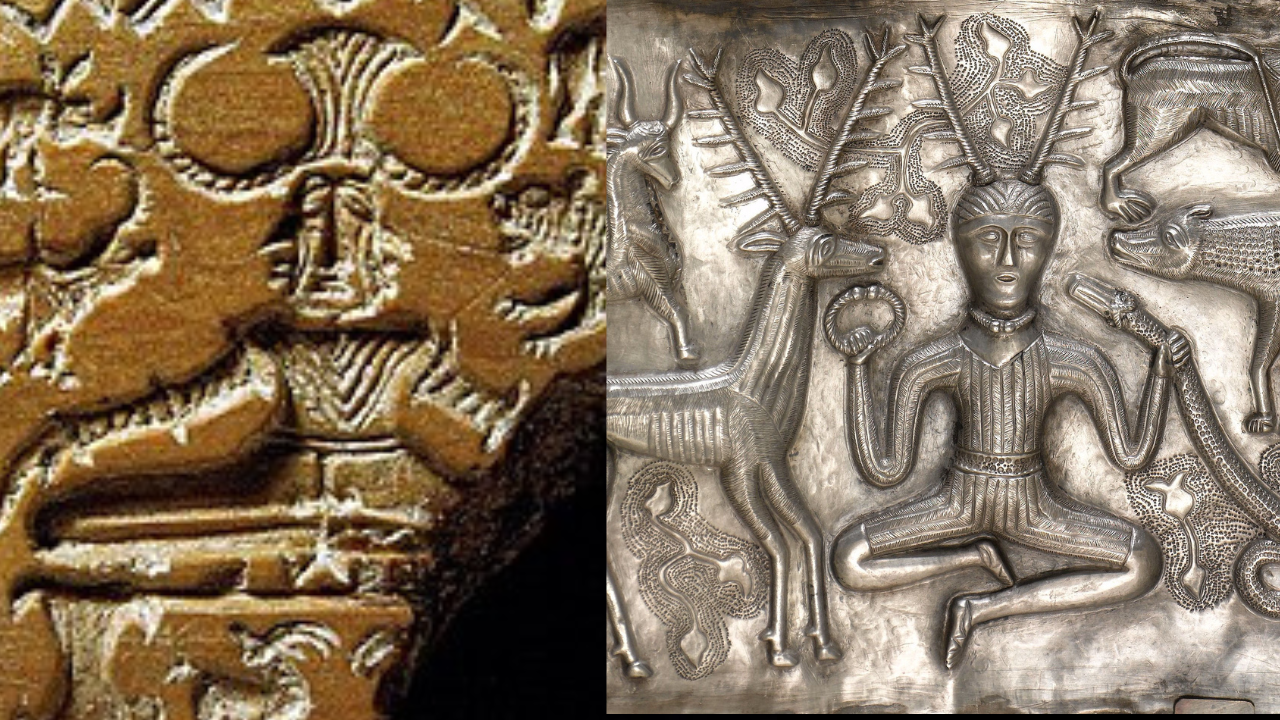
What if every version of the wild hunter - every psychopomp, every lord of the threshold, every horned figure at the edge of the firelight across every culture in human history - is actually the same being, seen through a different cultural lens?
What if the archetypes, the guides, the angels we've named and painted and carved and written about across thousands of years are all one thing, and what we're really looking at is the human experience of earth and the cosmos, shaped by the land we stood on and the language we spoke? That's the thread I keep pulling at. And it starts, as so many things do, with the stars.
Orion is one of the oldest recognised figures in the night sky, and what's remarkable is that almost every ancient culture that looked up at those stars saw the same thing - a hunter. Researchers studying global folklore suggest the Orion myth may stretch back as far as 12,000 to 15,000 BCE, tied to Ice Age astronomy and the migratory patterns of early humans. And following at his heel across the winter sky, the brightest star in the night sky - Sirius, his faithful companion.
But long before the Greeks were writing any of this down, the Egyptians had already been watching these same stars for thousands of years and telling a far older story. To them, the star we call Sirius was the goddess Sopdet - a divine feminine presence whose annual rising in the pre-dawn sky announced the flooding of the Nile, and with it, the return of life and fertility to the land. She was the celestial consort of Sah, their name for the constellation we call Orion. Over time Sopdet became identified with Isis, and Sah with Osiris - so that Sirius and Orion together became the eternal cosmic dance of Isis and Osiris, their movements in the sky mirroring the cycles of death and renewal on earth.
For the Egyptians, to rise to the vicinity of Sirius and Orion after death was considered the highest spiritual attainment possible. These weren't just stars. They were understood to be the actual celestial bodies of their primary goddess and god. A hunter in the sky, a feminine force alongside; a gateway between life and death mapped onto the heavens.
Now watch what happens when that same pattern touches the earth.
The earliest known image that many anthropologists connect to this lineage appears in the Trois-Frères cave in France, dating back to around 20,000 BC - roughly the same era as those earliest traces of the Orion myth in human culture. It's a figure often called the Sorcerer, a carved and painted image of what appears to be a horned, part-human, part-animal being, placed so deep within the cave system that reaching it would have required a real and difficult journey. Some researchers believe that was entirely intentional.
You had to earn the encounter with the shaman.
In ancient Egypt, Osiris - god of vegetation, death, and the underworld - is depicted with green skin and horns, a psychopomp standing at that same threshold between the living world and whatever lies beyond it. Identified in the stars as Orion himself, the hunter made flesh, the guide of souls made visible in a human cultural form.
Then, around 2700 BC, a steatite seal from the Indus Valley shows a horned figure seated in what looks remarkably like a yoga posture, surrounded by animals - a forest god, lord of wild things, thought by many scholars to be a precursor to Shiva in his form as Pashupati, Lord of Animals. A different land, a different language, a different face - and yet the same essential being looking back at you.
Cernunnos, the Celtic horned god, follows around the 4th century BC.
He had no recorded name until an inscription was found during the dismantling of a church in Paris, left there by sailors.
When you place his imagery next to the Indus Valley seal, the visual similarities are striking, and these two cultures had no known direct contact with each other.
Herne the Hunter appears in Shakespeare's writing in the 1500s - antlered, accompanied by a hound, wandering the forest at the edges of the known world. Then there's Pan - the Greek goat-footed god of the wild, of music and mischief, playing his pipes just at the edge of the firelight while the nymphs danced. His chaos, when you look closely at it, always seemed to lead somewhere worthwhile. Eventually his cloven hooves, his horns, and his wildness were absorbed into Christian imagery and merged with the figure of the devil, which wasn't accidental.
Early churches were frequently built directly on top of pagan sacred sites, and the traits of the old gods were deliberately woven into ideas of evil, because the Church understood that you cannot simply erase what people have held sacred for thousands of years - you have to transform it.
There's an interesting footnote here too. Pan is sometimes described as the only Greek god who ever truly died, based on a single passage written by Plutarch around 100 AD, in which a sailor hears a mysterious voice declaring that the great Pan is dead. Scholars have debated what this means ever since - some read it as referring to a minor local deity, others as a symbolic marker of the old world giving way to the new. It's one source, and its meaning remains genuinely contested, but it's a haunting image either way.
And then there's my own tradition. In the medieval Welsh manuscripts - specifically Culhwch ac Olwen and the Black Book of Carmarthen - Gwyn ap Nudd, whose name means White Son of Nudd, is described as a great warrior with a blackened face, king of Annwfn, the Welsh Otherworld, and leader of the Cwn Annwfn, the spectral hounds who ride with the Wild Hunt.
In the Black Book of Carmarthen he speaks of himself explicitly as a psychopomp, a gatherer of the souls of fallen warriors. "I have been where the soldiers of Britain were slain... I am the escort of the grave." He is the hunter at the boundary of life and death, moving through a landscape that exists just beyond the visible world, heard rather than seen - the baying of his hounds across a dark hillside, the omen that something is ending. He isn't described as horned in any primary Welsh source I can find, and I think it's worth acknowledging this rather than layering modern interpretations over what the actual manuscripts tell us.
What he shares with this whole thread isn't his appearance (though he has horns added later through association with the Fae) - it's his nature. He is the hunter at the threshold. He presides over the dark half of the year, over endings and the transformation that follows, over the wild and primal energies that sit just outside the warmth of the hearth fire.
He is the Welsh expression of the same current that flows through Osiris, through Orion, through the Sorcerer painted deep in that French cave twenty thousand years ago. And that, I think, is the point. A common thread does not diminish a characters divinity, if anything it adds to it, in my humble opinion.
The same archetypes, the same guides & Gods, perhaps even the same angels - all existing as one, but viewed through a human cultural lens, shaped by our human experience of earth and the cosmos.
The people of the Indus Valley looked up and found him in their way. The Egyptians found him in theirs. The Celts found him in the wild forests and dark hillsides of these islands. The Welsh found him riding through the night with his hounds, gathering the dead. None of them were wrong. They were all describing the same light coming through a different window. The name changes. The face changes. The land it grows from changes. But the being at the centre of it - the wild hunter at the threshold, the one who moves between worlds, who governs endings and the transformation that follows - that remains. Across every era, every culture, every corner of the world. Which makes me wonder whether these figures we've been taught to fear, to dismiss, or to file neatly into the category of mythology, are actually something far more alive than that.
What's your relationship with this archetype? I'd love to know which version of him speaks to you most.